Investing guide · Reviewed 28 August 2026
CAGR explained: what compound annual growth rate actually measures.
A CAGR calculator turns a starting value, an ending value and a number of years into one annualized growth rate. Here is what that rate means, why it is useful for comparing investments, and where it can mislead you if read the wrong way.
What CAGR measures and how the formula works
Compound annual growth rate answers one specific question: what constant annual rate, applied every year and compounded, would carry a starting value to an ending value over the stated period? The formula is CAGR = (ending value ÷ starting value)^(1/years) − 1. You divide the ending value by the starting value, raise that ratio to the power of one over the number of years, then subtract one to express the result as a percentage.
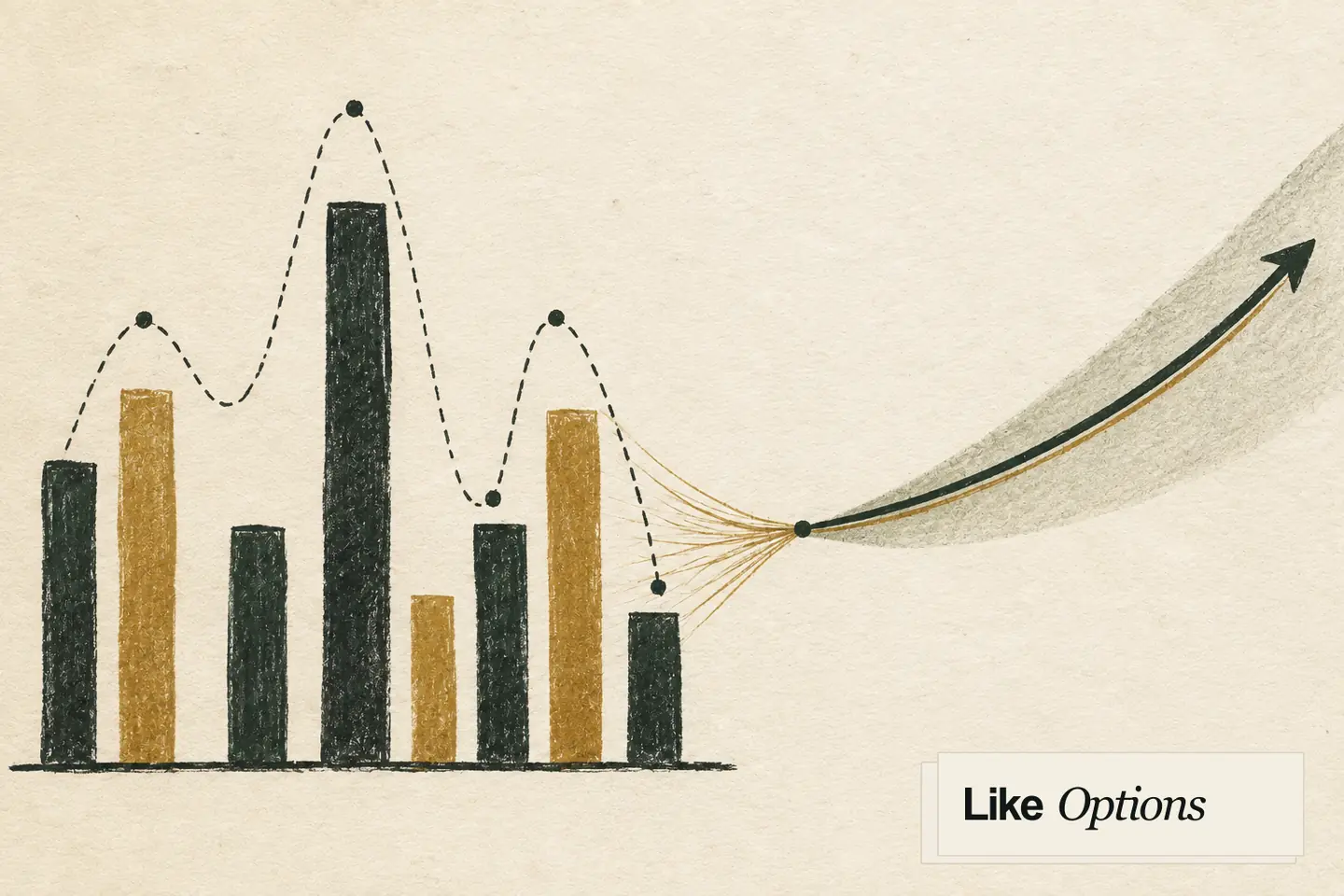
The key word is "constant." Real investments rarely grow at the same rate every year — a stock might gain 30% one year and lose 10% the next. CAGR ignores that path entirely and only looks at the two endpoints and the elapsed time. That is precisely what makes it useful: it converts a messy, multi-year growth pattern into a single number that behaves consistently, which is why a CAGR calculator only needs three inputs — starting value, ending value and years — to produce a comparable annualized figure. This also explains why the starting value must be positive: it sits in the denominator and under a root, so a zero or negative starting value makes the formula undefined.
Why CAGR matters for comparing investments across different assets and time periods
CAGR's real value shows up when you need to compare things that do not share a timeline. A stock held for 3 years, a property held for 12 years, and a fund held for 7 years cannot be compared meaningfully using total percentage gain alone, because total gain rewards long holding periods regardless of how efficiently the value grew. Annualizing each one with CAGR puts them on the same footing: a 40% total gain over 3 years annualizes to roughly 11.9%, while the same 40% total gain over 12 years annualizes to only about 2.8% — a very different growth rate hiding behind an identical headline number.
This is also why CAGR is widely used to evaluate long-term investments, business revenue growth, and portfolio performance side by side. A neutral CAGR calculator that only requires a starting value, ending value and time period lets you run this comparison instantly for any two assets or scenarios, without needing brokerage account data or a specific product's built-in reporting — you can test the numbers yourself and see exactly which formula produced the result.
What CAGR hides: volatility, cash flows and interim losses
Because CAGR is calculated from only two data points — the start and the end — it says nothing about what happened in between. Two investments can post an identical CAGR while one grew smoothly and the other lost 50% in year two before recovering sharply. If the path matters to you (for example, because you might need to withdraw money mid-period), CAGR alone will not reveal that risk.
CAGR also excludes contributions and withdrawals. If you added money partway through the period, a plain CAGR calculation will overstate the return, because it treats the entire ending value as if it grew from the original starting value alone. For a portfolio with recurring contributions, a money-weighted or cash-flow-adjusted return method is more accurate than CAGR. Use CAGR when you are comparing a single lump-sum start and end value; use a different method — such as an internal rate of return, or this site's SIP or compound interest calculator — when contributions or withdrawals happened along the way.
How to use a CAGR calculator without misreading the result
Enter the starting value, the ending value, and the number of years elapsed. The calculator returns one annualized rate — treat it as a summary statistic, not a guarantee or a forecast of future performance. To get real use out of it, run the same calculation for several assets or scenarios you are comparing, using the same time period for each where possible, and note that a higher CAGR does not automatically mean a better investment once you account for the volatility and risk it took to get there.
It is also worth sanity-checking edge cases: a negative CAGR simply means the ending value was lower than the starting value; it does not mean the calculator is wrong. And because CAGR compounds a ratio, doubling your elapsed time roughly halves the annualized rate needed to reach the same ending value from the same starting value — useful intuition when judging whether a stated growth rate is realistic over a longer horizon.
Calculate CAGR instantly ↗ Compare against a compound interest projection ↗
Frequently asked questions
What is CAGR in simple terms?
CAGR (compound annual growth rate) is the single constant annual rate that would take a starting value to an ending value over a given number of years, if growth had been perfectly smooth every year. It compresses a multi-year change into one comparable percentage.
What is the CAGR formula?
CAGR = (ending value / starting value)^(1/years) − 1. Divide the ending value by the starting value, raise the result to the power of one divided by the number of years, then subtract one and express the result as a percentage.
Is CAGR the same as average annual return?
No. A simple average of yearly returns can overstate performance because it ignores compounding and the order of gains and losses. CAGR is derived from only the starting and ending values, so it reflects the actual compounded outcome, not an arithmetic mean of intermediate returns.
Can I use CAGR to compare two different investments?
Yes, that is its main use. Because CAGR expresses growth as one annualized rate, you can compare a stock, a fund, a property, or a business metric over different time periods on the same basis, as long as you remember it ignores volatility and interim cash flows.
Why does a CAGR calculator need a positive starting value?
The formula divides the ending value by the starting value and takes a root of the result. A zero or negative starting value makes that calculation undefined or meaningless, so a CAGR calculator requires a starting value greater than zero.
Source note: This guide uses the standard compound annual growth rate formula. All calculations happen in your browser — nothing you enter is sent to a server or stored. This is educational financial information, not investment advice or a product recommendation.