Inflation guide · Reviewed 28 August 2026
Inflation and purchasing power: calculating the real impact.
A fixed amount of money buys less over time when prices rise. Here is the formula behind that erosion, how to check whether your savings or returns are actually keeping pace, and what an assumed inflation rate can and can't tell you.
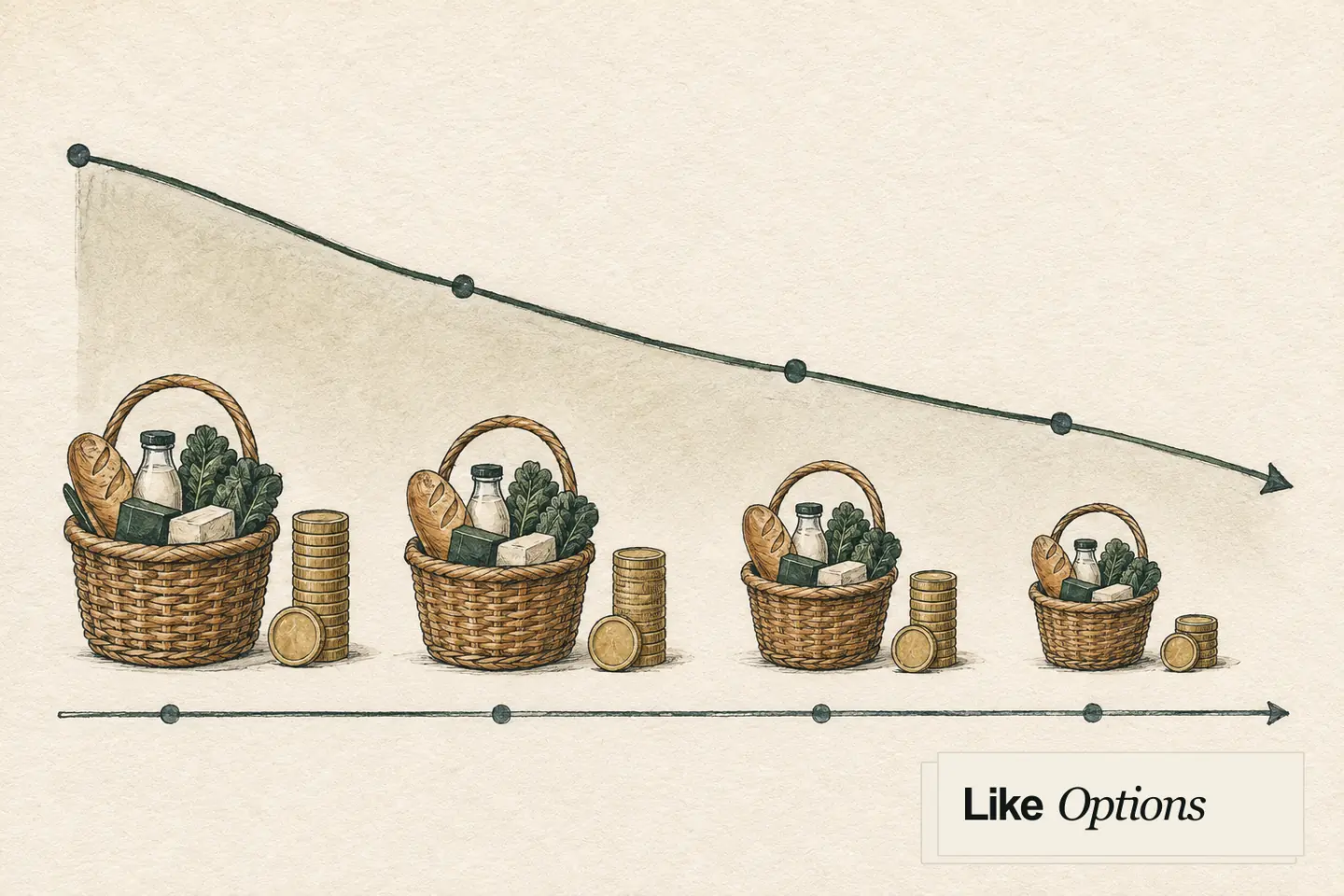
The formula behind purchasing power erosion
Inflation calculations use one core formula: FV = PV(1+i)^t, where PV is an amount today, i is the assumed annual inflation rate, and t is time in years. Applied forward, this tells you what a future equivalent cost would be — if something costs $1,000 today and prices rise 3% annually, the equivalent cost after 10 years is roughly $1,344. Applied in reverse, the same formula tells you what today's purchasing power of a fixed nominal amount will shrink to by a future date, since a fixed sum buys proportionally less as the equivalent cost of goods rises.
The single assumed rate is the model's key simplification. Real-world inflation is not constant: it varies year to year, differs across categories of goods (housing, food, energy), and differs by region. Treat the entered rate as one scenario worth testing, not a fixed forecast of what will actually happen to prices.
Checking whether your savings rate is actually keeping up
A savings or investment return only preserves purchasing power if it exceeds the inflation rate over the same period — this is the difference between a nominal return and a real (inflation-adjusted) return. A savings account paying 2% while inflation runs at 4% is still losing purchasing power every year, even though the account balance is growing in nominal terms. To check this properly, compare the two rates directly for the same period rather than assuming any positive return is automatically sufficient.
This distinction matters most for long-horizon goals like retirement, where small negative real returns compound over decades into a large gap between the nominal balance you accumulate and what it can actually buy. When comparing a projected future balance against a spending target, always express both figures in the same terms — either both nominal, or both inflation-adjusted — rather than mixing the two.
Using an inflation calculator to compare scenarios
Enter today's amount, an assumed annual inflation rate, and a time period to see either the future equivalent cost of that amount, or how much a fixed sum's purchasing power would erode by that future date. Run the calculation at a few different assumed rates — a low, moderate and higher inflation scenario — to see how sensitive the result is to that one assumption, especially over periods of 15 years or more where small rate differences compound into large gaps.
It's also useful to run the same calculation on a specific expense category you care about (education costs, healthcare, housing) using a rate more specific to that category, since broad inflation measures can understate or overstate how a particular cost you're planning for is likely to change. Treat the calculator's output as one input into a larger plan, not a substitute for checking category-specific price trends when the stakes are high.
Estimate future purchasing power ↗ Apply this to a retirement projection ↗
Frequently asked questions
What is purchasing power?
Purchasing power is how much a given amount of money can actually buy. When prices rise faster than the nominal amount of money you hold, purchasing power falls even though the number in your account stays the same or grows.
How do you calculate the impact of inflation on savings?
Use the formula FV = PV(1+i)^t, where PV is today's amount, i is the assumed annual inflation rate, and t is the number of years. This estimates what today's amount would need to grow to in order to buy the same goods and services in the future — the inverse of this calculation shows how much today's purchasing power has eroded by a future date.
Does a savings account return beat inflation?
It depends entirely on the account's interest rate versus the inflation rate over the same period. If the interest rate is lower than inflation, the real (inflation-adjusted) value of the savings is falling even as the nominal balance grows. Compare the two rates directly rather than assuming any positive return automatically outpaces inflation.
Is the inflation rate used in a calculator a forecast?
No. An inflation calculator uses an assumed rate you enter — it's a modeling input, not a prediction of what will actually happen. Actual inflation varies year to year and differs by category of goods and services.
Can purchasing power calculations use a negative inflation rate?
Yes. A negative rate models deflation — falling prices — in the same formula. This is a valid input for exploring scenarios, even though sustained deflation is uncommon in most modern economies.
Source note: This guide uses standard future-value mathematics applied to an assumed inflation rate. All calculations happen in your browser — nothing you enter is sent to a server or stored. This is educational financial information, not an economic forecast.