Debt guide · Reviewed 28 August 2026
If your payment barely beats the interest, payoff time explodes.
Unlike a fixed-term loan, revolving debt payoff has no formula you can solve in one step — it has to be simulated month by month, and that simulation reveals how dangerous a "minimum payment" really is.
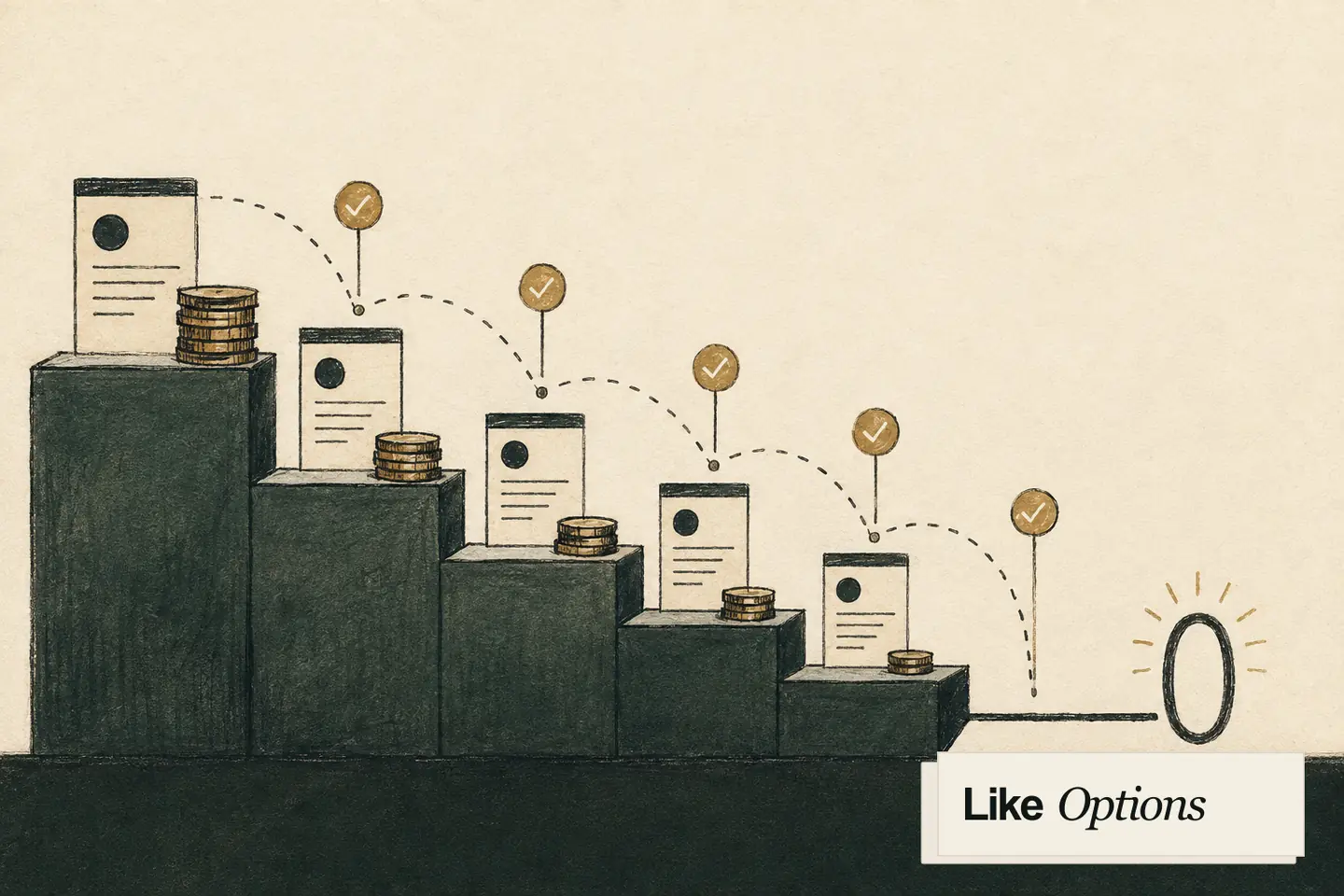
Why payoff time is simulated, not solved directly
A fixed-term loan (a mortgage, an auto loan) is designed so a constant payment retires the balance in a known number of months — that's a formula you can solve for directly. Revolving debt payoff at a chosen payment amount works differently: each month, interest accrues on whatever balance is left, gets added to that balance, and then the payment is subtracted. Because the balance keeps changing, there's no single equation — the calculation has to step forward month by month until the balance hits zero.
The minimum-payment trap
The danger becomes obvious once you simulate it: if your payment is only marginally larger than the interest accruing that month, almost the entire payment is consumed just keeping pace with interest, and the balance shrinks by almost nothing. Push the payment down far enough — to less than or equal to the monthly interest charge — and the balance stops shrinking altogether, or grows, because unpaid interest compounds into the balance. This is exactly why credit card minimum payments, often set as a small percentage of the balance, can stretch payoff into decades.
Why extra payment has an outsized effect
Every extra dollar above the interest charge goes straight to principal, and a smaller principal means a smaller interest charge the following month — a compounding effect that runs in your favor. On high-rate revolving balances, even a modest increase in monthly payment can cut years off the payoff timeline, because you're not just paying down the balance faster, you're reducing the interest base for every remaining month.
What the debt payoff calculator computes
Enter your current balance, the annual interest rate, and a fixed monthly payment. The calculator simulates the balance month by month and returns the estimated payoff time, total interest paid, and total amount paid — or flags the payment as too low to ever clear the balance.
Estimate your debt payoff time ↗ Check your overall financial health score ↗
Frequently asked questions
How is debt payoff time calculated?
The calculation runs month by month: each period, interest accrues on the remaining balance (balance × monthly rate), that interest is added to the balance, and your payment is subtracted. This repeats until the balance reaches zero. The number of months it takes is your payoff time — there's no closed-form shortcut because the balance changes every period.
Why can a small monthly payment take decades to clear a balance?
If your payment is only slightly larger than the interest accruing each month, almost none of it reduces principal — the balance shrinks extremely slowly. In the extreme, if the payment is less than or equal to the monthly interest charge, the balance never shrinks at all; it can even grow.
What happens if my payment is less than the monthly interest charge?
The balance stops decreasing and can increase, because the unpaid interest gets added to what you owe. This calculator flags that condition rather than returning a payoff time, since one doesn't mathematically exist under those assumptions.
Does paying a little extra each month make a big difference?
Often, yes — disproportionately so on high-rate revolving debt. Extra payment goes entirely toward principal, which reduces the balance interest is calculated on for every future month, compounding the effect over the life of the payoff.
Does this calculation account for multiple debts or a payoff strategy like avalanche or snowball?
No — this models a single balance at a single rate against a single monthly payment. Prioritizing which debt to pay off first when you have several (by highest rate, or by smallest balance) is a separate strategic decision this calculator doesn't make for you.
Source note: This guide describes a general month-by-month payoff simulation. All calculations happen in your browser — nothing you enter is sent to a server or stored. This is educational information, not debt or credit counseling advice.